Assignment 5 · Research & Reflection

Feedback from Assignment 5

An immediate improvement for this assignment would be to ensure I provide an introduction that outlines the line of discussion clearly. Whilst I think introduced Do Ho Suh’s work, I perhaps didn’t highlight what themes and ideas I would intend to look at in the essay.

My tutor also commented on the fact that I should ensure I start each paragraph with my own statement or opinion, rather that a quote. Instead I should follow it up with a quotation in order to back up my point.

Early on I acknowledge that Suh comments on concepts of space and home in his work, however I could’ve expanded on this further. For instance, one aspect of these themes that interests me is a sense of place and belonging. This feeling is usually created when we become familiar with a space and develop an emotional connection. A home is probably one of the most personal spaces to an individual which is why Suh’s work is so relatable. He shares a representation of the spaces he called home during his life and takes us on a trip of these various locations. This allows us to reflect on the places and homes we may have lived in, obviously this varies depending on experience. Some people may have only lived in one location whereas others may have moved multiple times, for both positive and negative reasons. This links to the idea of ‘rootlessness’, a term my tutor highlighted, which was used by Stalin as a term of denigration. It is something I’d definitely look into further when thinking about Suh’s hubs again.

In order to develop my essay further my tutor suggested I consider both social and aesthetic aspects of a home. For people that are homeless, a home would offer a solid, private house. Therefore it is probably more about function and safety, than the nostalgia created by memories and experience.

I would also consider the title ‘Passages’ more closely. The meaning of connecting places obviously makes sense in reference to Suh’s hubs as it allows you to travel to the different homes he lived in. However, as my tutor pointed out, the term can also be associated with sea-voyages, such as the Middle Passage in reference to the Slave Trade. If I was to look at rewriting this essay, I would ensure that I gave more thought to why he might have named the installation ‘Passages’.

My tutor also identified that I have looked at other textile artists and wider themes of fashion and textiles in my learning log. To expand on my essay I could have compared Suh with some of my wider research. Looking at it now, there are similarities in Christian Boltanski’s installation ‘Personnes’ (2010). Like Suh’s hubs, this is a large installation that transformed the space it was displayed in. However the connection between the two is more about the personal aspect. In Boltanki’s installation, he uses the sound of heartbeats and each one is unique to a person. The pile of clothes also represent people, symbolising someone’s life and story. Therefore there is an emotional side to his work, like Suh’s. In Passages, the hubs represent the homes he inhabited and the stages of life.

You could also compare Suh’s hubs with Yayoi Kasama’s ‘Infinity Mirrored Room’ (1998). Both installations are immersive and due to the bright colours, it’s like you’re being transported from reality and to somewhere other-worldly.

Suh’s Passages comment on the importance of a home – both the function and mental health aspect – often improved by a feeling of belonging and connection in a familiar space of safety. You can also think about wider issues such as sustainability, when building homes you need to consider where the materials are sourced, as well as the use of machinery and electricity, It can be done sustainably by working with the environment more – like using renewable energy sources but this is something that still needs improvement in the building industry.
Assignments · Coursework · Research & Reflection

Conclusion

Looking back on my experience of the CAT course, it’s clear that my research skills and confidence in discussing the information has improved greatly. In my opinion, I feel like my later work, particularly my assignments, show an ability to research wider themes and concepts which help me to form a more critical analysis.

Research is an integral part of all learning and is a skill I have and will keep improving throughout studying with the OCA. The ability to utilise different resources – both primary and secondary allows you to gain a better understanding of the subject, whilst allowing you to refer to wider themes, concepts and theories.

I always ensure I dedicate a large amount of time to the research I put into my work, perhaps too much time sometimes but without this research, I wouldn’t feel as confident in commenting on a subject as complex as the creative arts. Often I found it beneficial to create a mind map, outlining my initial thoughts and the areas I wanted to research further. Doing this helped me to collect my thoughts before collecting both primary and secondary research.

Visual research and investigations are just as important as the theoretical, especially in such a visual course like Creative Arts Today. I find that they prompt more contemplation because the information isn’t necessarily as obvious to it causes you to think about the subject on a deeper level. Often it may represent various concepts and themes already mentioned in other research but seeing it visually can help you to understand better or consider it from different perspectives. I think this is particularly important in a creative course because there often any wrong or right answers in art – it’s subjective and can mean something very different for each person.

You can then research the potential themes, symbolism and concepts further to develop your knowledge and gain a better understanding of context. This may be about a movement, other artists/designers, characteristics of someone’s work etc.

To begin with, I found it challenging to ensure that my points were backed up by a reference in any assignments. Although I’d done extensive research, I perhaps hadn’t organised it enough and written down the sources in which I found the information clearly. There are stages to research and the organisation of it is vital to ensuring you are able to build a well thought out essay.

Upon reflection of the work I’ve explored and analysed during this course, there are definitely some themes and concepts that are more common. Place and Time were obviously running themes but in addition, I found that concepts such as life and death could also be linked to many of the works I looked at.

Therefore, theoretical research is important and can help you to understand why an artist, writer, photographer or designer may have made a certain choice. However, it is the visual research that what develops your own opinions and connection to the work.

Assignment 5 · Research & Reflection

Assignment 5: Research

There were two prompts for this assignment and I opted for this one:

‘Select an art installation where its primary medium is considered a textile. Analyse its formation and contextual presence; question the creation of the piece and if it has been informed by the space it inhabits or if there is no connection and the gallery/environment is a secondary component.’

I decided to look at Do Ho Suh’s ‘Passage/s’ for this last assignment.

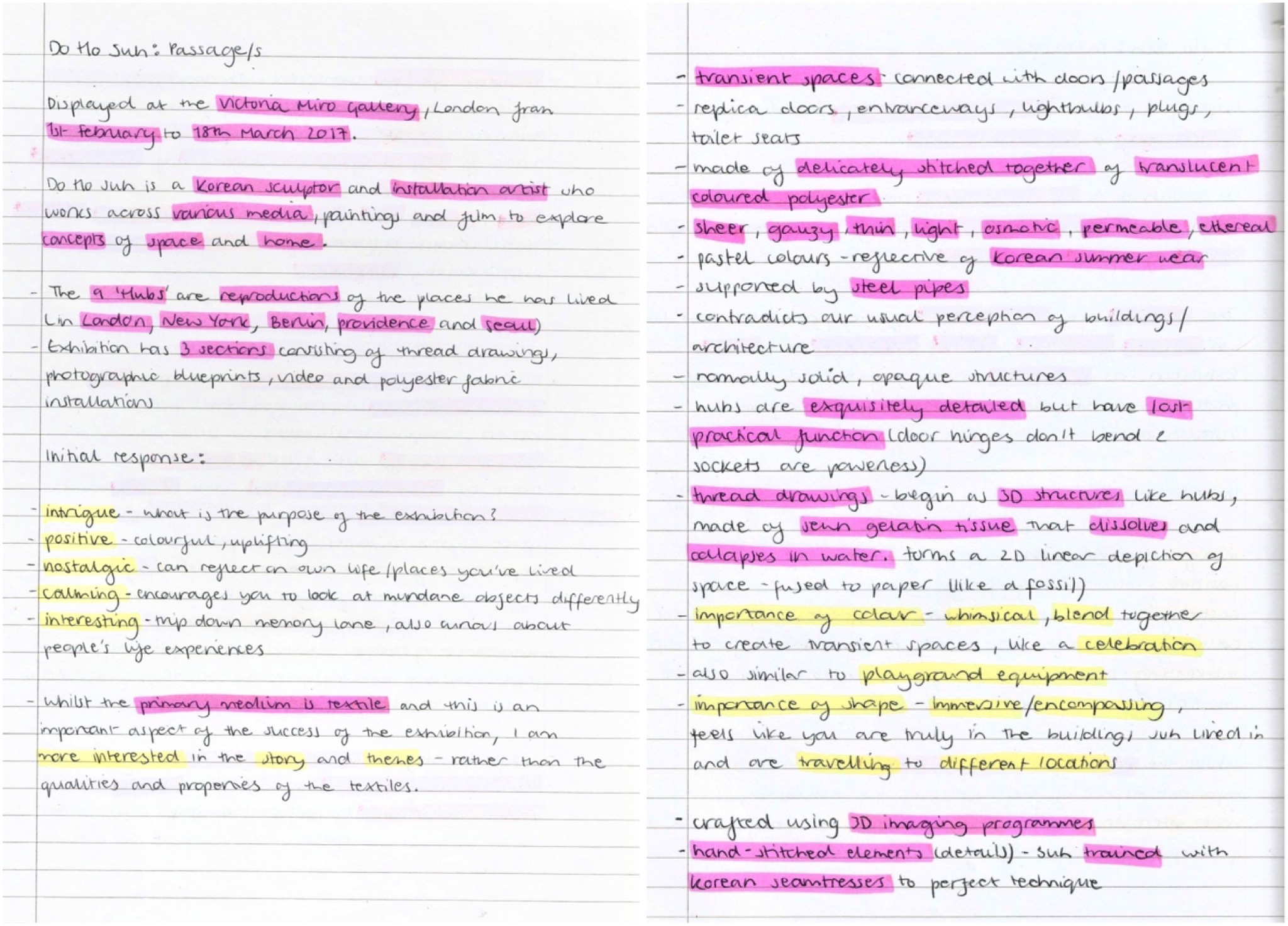
IMG_3479

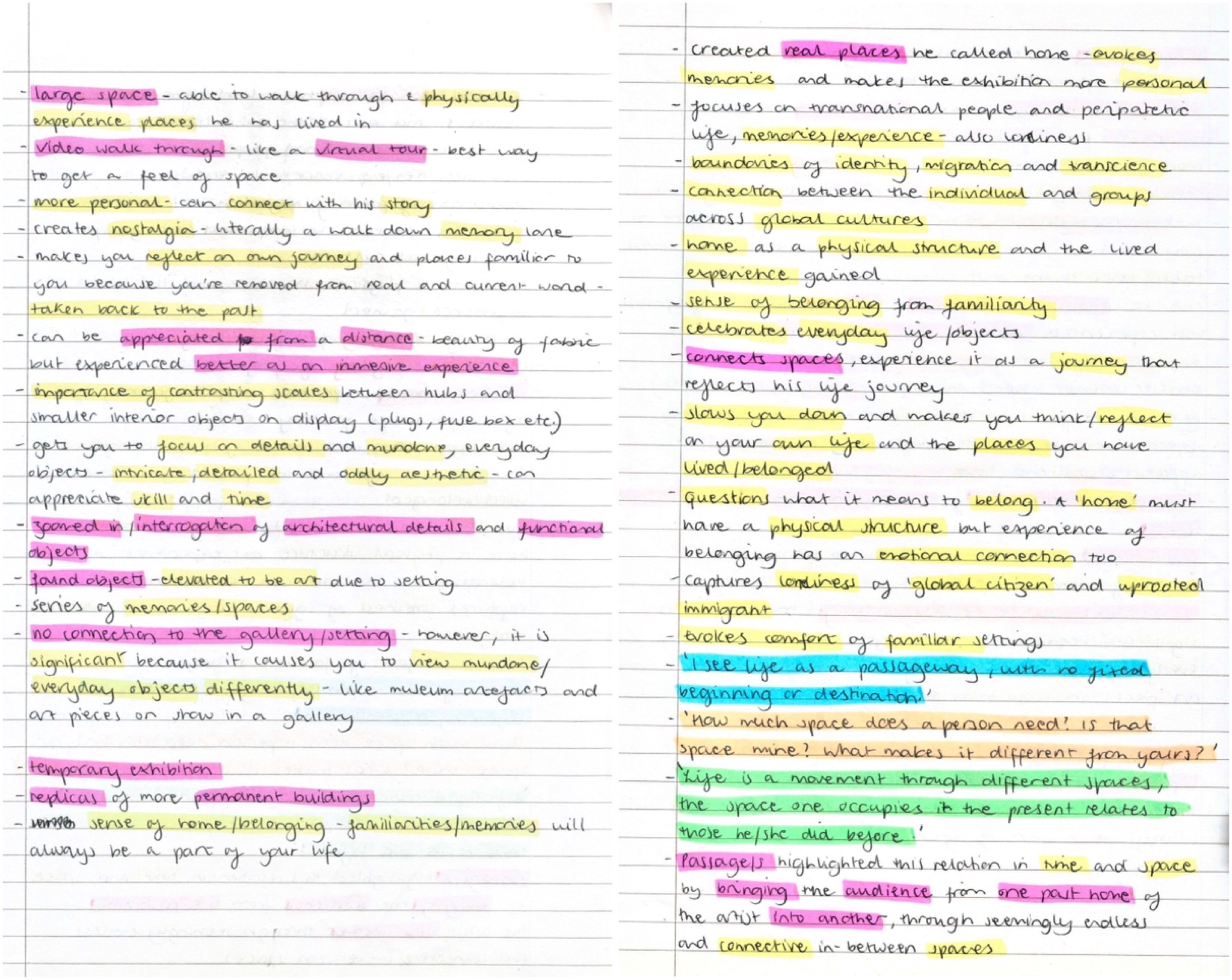
When researching and planning for any essay I always prefer to write down my notes before typing anything up. I find it easier to collect my information so that I have it to refer to when starting to write my essay and always highlight the key details to ensure I include them.

I attempted to arrange my notes as best as I could – for example, I wrote down my initial thoughts, the physical properties/qualities of the textiles and then looked at the work in regards to wider themes and concepts.

IMG_3480

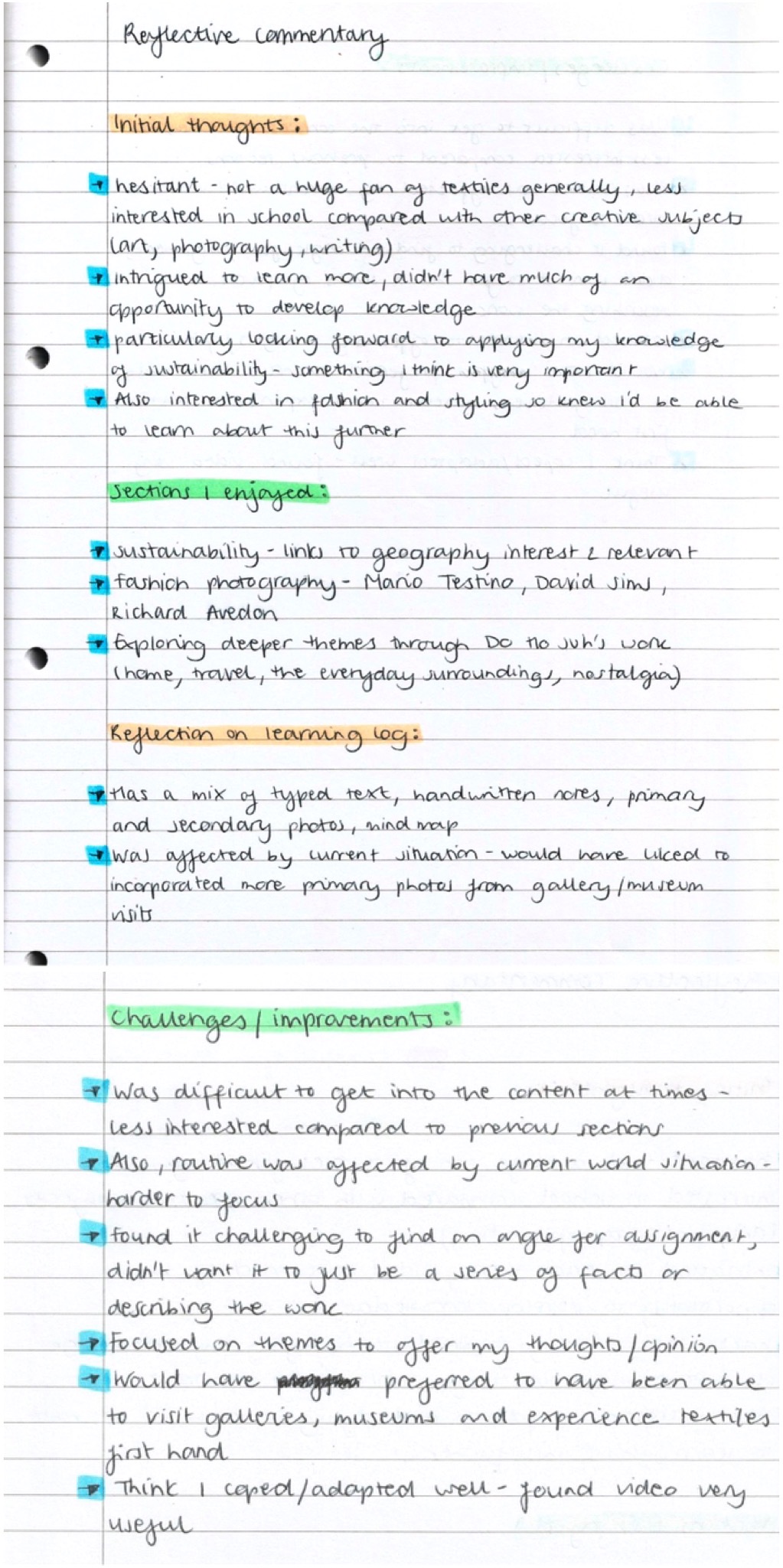
Below are my notes for my reflective commentary about Part 5 as a whole, including my initial thoughts and the parts of the Textiles content I enjoyed most.

IMG_3481


Assignment 4 · Research & Reflection

Feedback from Assignment 4

I know I need to spend time gathering my references when planning for my essay as this will help to ensure I find it easier to integrate them better. In doing this, my points and comments are backed up fully and readers know where I’m getting my information from.

My tutor also suggested I could analyse the ideas of time and place in greater detail. Hockney’s Joiners lend themselves well to these as he stretches the boundaries of time and place in his process of work and subject matter. I’ll try to look at this more closely to offer better analysis.

Linking to this, my tutor advised that I consider what a ‘better sense of place’ actually means. When using this phrase I know what I mean, however, I understand this isn’t always clear to the reader so I need to ensure I explain this. To me, a general sense of place means that someone can experience and become familiar with it, even if they haven’t physically visited themselves. Photography allows people to see images of places around the world in which they wouldn’t have seen otherwise.

Notes · Part 4

Family Photos

In the course materials, it says that family photos are often cited as being the possessions that people would most want to save from a house fire. A statement I agree as my photos are things I always want to keep.

Why are photographs such a significant part of our lives?

  • They hold so many memories and allow you to feel nostalgic about them
  • Are a way of seeing things/people change – can watch people grow up (I have pictures of my whole life and enjoy looking back on them)
  • Can share experiences easily through visual means – “a picture tells a story’
  • Way of capturing the past so it can be viewed in me present & future

How do I feel about photos and videos from my family’s past?

  • nostalgic
  • happy
  • interested – particularly in photos from before I was born’ like ones of my Parents/Grandparents
  • amusing – especially videos
  • curious – resemblance
Part 4 · Research & Reflection

What makes photographs unique?

For me, photographs are a way to capture memories. They are unique because they allow you to save a specific moment in time. Other forms of art can do this but they aren’t as instant. If someone is painting a landscape then the general composition and subjects stay the same but as time passes then certain things can differ, such as lighting, weather and movement (eg. from falling leaves or creatures. However, a photograph allows an exact moment to be saved and viewed again, even when it can’t be replicated perfectly in physical life.

I take photos frequently, usually because I want to be able to look back on it and reflect on the memory. Some photos are set up – such as asking people to smile and pose for a photo. I think these are more of an artificial version of ‘unique’, they are still capturing one moment in time but are easier to recreate. Spontaneous and candid photos are more unique because people’s movement/facial expressions are more realistic and less ‘forced’ so they also capture the mood better too. These are more nostalgic to look back on because it can help you visualise a memory more organically. Also, photos allow you to look back on history – both short and long term, which can help people to experience or understand certain events better. This can also help to create a sense of time and place too.

I also take photos of things I think are aesthetically pleasing, interesting or impressive. Unlike other art forms, photography is unique in the way it allows you to save something you see visually that may only last a second. For example – the way the sun is reflecting, how the wind blows someone’s hair, a snowflake landing before it melts. These are all things that can be replicated through various artforms but a photograph is unique because it’s something that genuinely happened and was seen. People often talk about taking a ‘mental picture’, often they blink as if they are trying to save what they see and this is essentially what a photograph is – except it’s something you can physically view.

Nowadays, many photos exist purely as digital copies only and whilst they can be described as unique, creative or even artistic, usually, they aren’t seen as a work of art.  Also, we come across photos daily that may be used for other purposes – like in an advertisement. We often pay attention to the subject, particularly if it is a product or brand that interests us, yet we rarely see the image as a piece of photographic art. As I’m interested in art and photography I’d say I probably think about the photos I see daily more than someone who is less interested. This is because I like experimenting and wonder how the photo was taken and edited to achieve the desired result, if I do this I am more likely to see it as a form of art.

However, if a photo is displayed (especially in a gallery) then it is now classed as art by the majority of people and it is contemplated in the same way a painting would be. For instance, the composition, lighting, mood, colours and other choices the photographer has made. Therefore, a photo is also unique in the way it is viewed – depending on the context.

Assignment 2 · Research & Reflection

Feedback from Assignment 2

The feedback from my second assignment was very useful and eye-opening. My tutor questioned whether song lyrics can ever be considered apart from the band, music and performance.

I don’t think there is any reason you shouldn’t be able to analyse song lyrics in the same way you do poetry. Many songs are well thought, creative and have a narrative line in the same way poems do. However, I agree with my tutor’s comments about how you either need to argue a case for ignoring the music (which risks diminishing the overall song). Alternatively, you can show how the music supports, increases or lessens the impacts of the words. I’ll certainly be looking to incorporate some better analysis into the music when I re-write my essay for assessment.

She also pointed me in the direction of a BBC article written after Bob Dylan won the Nobel Prize for Literature in 2016 – particularly for poet Simon Armitage’s comments. In the text, he says ‘songwriters are not poets, or songs are not poems…in fact, songs are often bad poems.’ He details reasons for this opinion which is something I’ll definitely look at when I come back to this assignment to make improvements.

Other feedback from my tutor includes being clearer about how certain poetic devices and techniques impact how a lyric is interpreted. I’d given some examples but perhaps not explained in depth so I’ll try to ensure I expand on this in future work and when improving this essay.

Assignment 1 · Notes · Part 1 · Research & Reflection

Feedback from Assignment 1

In this post, I’m going to reflect on the feedback that was given to me in regards to Assignment 1. Obviously, since it was the first I’d done, I was expecting and hoping for some constructive criticism. Whilst I enjoy writing essays and responding to an overall question, I’d not done anything like it since finishing my A Levels two years ago so wasn’t sure what exactly was expected.

I enjoyed the experience of studying independently and the responsibility that comes with it. It was hard not to procrastinate at times but overall I think I worked hard and am pleased with the content I produced in this first unit.

I’m glad I chose to keep an online learning log in the form of a blog, being able to look back at different exercises is useful and I know this will benefit me throughout the course. So far I’ve preferred to write my initial notes by hand but find it relatively easy to type them up as a final draft in my learning log.

In regards to Part A of the assignment, my tutor encouraged me to go into more detail with the points I make. For example, I should reference particular works of art rather than making more open and generic comments.

I was also reminded that I need two separate bibliographies for both Part A and B. I’d say this was definitely one area I was expecting to receive some improvements on as I’ve not used the Harvard Referencing System before. My tutor gave some helpful tips, especially in regards to the references in Part B – like ensuring I always put the last name first of the artist, author etc. I’ve now spent more time looking back at the referencing system and hope to use it in my work more consistently.

Additionally, my tutor said that I made some perceptive comments in Part B but that some were more generalised and could be improved if I backed it up with a specific piece of art. For instance, I referenced Baroque paintings but didn’t name a particular piece.

These are all things that I think should be fairly straightforward to improve upon when working towards my future assignments, however one aspect that I did have some trouble with was the word count. I’m definitely someone who writes a lot so sticking to a strict word count was a challenge and the thought of having to add in extra detail did make me wonder how on earth I’d fit it in! I actually read over my assignment again to add in some of the specific artworks and then tried to make my points more precise to stick to the word count. It was something I found easier than I thought I would and am glad I practised a bit before doing the next assignment.

At this early stage I’m not sure if I would choose to pursue Contemporary Art at a higher level, however I feel more confident in my ability to write a critical essay based on my research and know this will only improve as I progress through the course.

Overall I think the main aspects that I need to work on going ahead is my references and bibliography, as well as ensuring I utilise my research and the pieces of work I’ve looked at in my learning log. Hopefully, I can make these improvements in my future assignments.

Assignment 1

Assignment 1: research and reflection

Part A of Assignment 1 for the Contemporary Arts section is to reflect on the question ‘what is art’. I then had to reflect on what I’ve learnt, what I’d like to develop and how I think my learning log is progressing and can be improved. Below are my written notes that I used to help gather my thoughts and type up my response to the assignment.

IMG_8131

IMG_8130

For part B, I had to research ‘The Battle of Orgreave’ by Jeremy Deller and then write a 1000 word response. This should give my interpretation on the piece and reflect on the importance of time and place. Again, below are my research and essay planning notes.

IMG_8132

IMG_8133

IMG_8134

IMG_8135

Reflection in regards to assessment criteria:

Demonstration of subject-based knowledge and understanding – In my assignments I think I show a strong level of understanding and that I’ve clearly researched the subject. For instance, I didn’t know much about The Battle of Orgreave but have included various contextual information such as dates and facts to back up my response. Furthermore, I tried to convey my own opinions in order to show my understanding of the piece.

Demonstration of research skills – I believe I have displayed my research skills well as I have utilised various sources such as the internet (including articles, reviews, videos and images) and books to gather information about the subject. Additionally, I believe that the images above show that I can clearly plan and carry out a research project with the aim to write an essay.

Demonstration of critical and evaluation skills – Within my assignment, I have displayed evidence of these skills through the discussion of Deller’s piece. For instance, I evaluated the piece and questioned the concept of contemporary art and whether it can be classified as such. I also analysed the piece itself and backed up my thoughts with reviews from critics in order to synthesise contextual information and my own interpretation. In regards to the subject of time and place, I tried to show that I can engage and debate the importance of these themes within a piece of art.

Communication – I am confident in my ability to communicate my ideas in an engaging way, in order to best show the knowledge I have gained and how my thoughts develop. I like to present my response in clear paragraphs so that a clear beginning, middle and end can be identified, but also so I am able to communicate the points I want to make. Furthermore, I understand that images are not always necessary and should only be used if relevant, as I am a visual learner I believe the use of some images can help the reader to picture the subject whilst reading my interpretation. Therefore I included two images in my essay but think this is well balanced in the overall presentation.